
Fiber-optic cable
A fiber-optic cable may refer to any of the following:
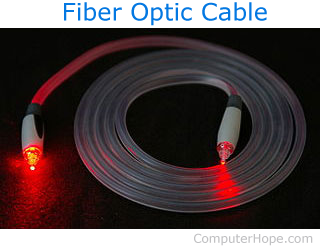
1. A fiber-optic cable defined in IEEE 802.8 is a cable containing optical fibers (usually glass) coated in plastic to send data by pulses of light. The coating helps protect the fibers from heat, cold, electromagnetic interference from other types of wiring, and some protection from ultraviolet rays from the sun. Fiber-optics allow for faster data transmission than standard copper wires because they have a higher bandwidth and are symmetrical. Fiber-optic connections are common amongst corporate networks or world-wide networks, such as Internet backbones, because of the cable's capabilities.
How is data transmitted on a fiber-optic cable?
Data is transmitted by sending pulses of lights that represent a binary signal. In other words, when a router or other device receives the incoming signal over a fiber-optic cable, no light indicates 0, and a light indicates 1. Combining these 0's and 1's builds the data being transmitted.
Because nothing can transfer data faster than light, fiber-optic cables offer the fastest method of transmitting data.
Fiber-optic cable precautions
When handling and using fiber-optic cables or fiber-optic networking equipment, keep the suggestions below in mind.
- Keep the fiber connections and connectors capped when not in use to help prevent dust, dirt, or other substances from getting on the connector.
- Always keep the fiber connections and connectors clean.
- Do not allow the fiber cabling to bend more than the diameter of your hand. Bending the cable further could cause physical damage to the cable.
- Do not touch the tip of the actual fiber cabling, as it could cut you.
- Never look down the fiber cabling when in use as light pulses are being used. To determine if the pulse is getting sent, use a meter.
Should I use "fiber" or "fibre" in my writing?
Both versions are correct. If you're writing for an American audience, "fiber" is preferred. If you're writing for a British or other audience, "fibre" is often preferred. Because Computer Hope is an American company and we want to be consistent, we've chosen to use "fiber" in our writing.
2. In TV and stereo systems, an optical cable is used to transmit sound from a DVD (digital versatile disc) player or TV to a sound system (e.g., stereo receiver or sound bar). The optical cable can transmit high-quality sound, ensuring little or no sound degradation.
Data cable, Digital line, FDDI, FTTP, Hardware terms, Lightwave system, Multi-mode fiber, Network terms, Optical communications, Optical fiber, Single-mode fiber, SONET