
SIO
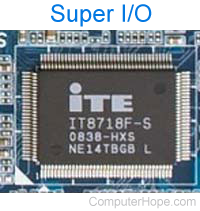
Short for super input/output, or super I/O, SIO is an integrated circuit on a computer motherboard that handles the slower and less prominent input/output devices shown below. When the super input/output was created in the late 1980s, it was found on an expansion card. Later, this chip was embedded into the motherboard and communicated over the ISA (Industry Standard Architecture) bus. As ISA stopped being used with computers, SIO communicated over the PCI (peripheral component interconnect) bus. Today, super I/O communicates through the Southbridge and is still used with computers to support older legacy devices.
Computer devices handled by the super I/O
- Floppy disk controller
- Game port
- Infrared
- Intrusion detection
- Keyboard and mouse (non-USB)
- Parallel port
- RTC (real-time clock)
- Serial port UART (Universal Asynchronous Receiver-Transmitter)
- Temperature sensor and fan speed.
Some newer chipsets are combine Southbridge and super I/O chips into a single chip and refer to this chip as the Super Southbridge chip. Some manufacturers, such as NVIDIA and SiS, have combined the Northbridge, Southbridge, and super I/O into a single chip.
How do I know which integrated circuit is the super I/O on my motherboard?
Identifying the super I/O on your motherboard is easy if you look for an integrated circuit labeled with a company's name that manufacturers super I/O chips. Some common super I/O manufacturers are Fintek, ITE, National Semiconductor, Nuvoton, SMSC, VIA, and Winbond.
Computer acronyms, Motherboard terms, Northbridge, Southbridge, Super