
UART
Updated: 06/06/2021 by Computer Hope
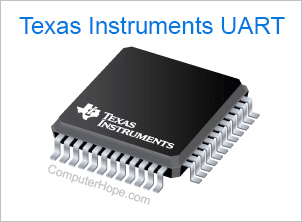
Short for Universal Asynchronous Receiver-Transmitter, UART is a chip used to manage computer hardware devices which require timing. These devices include computer serial ports, disk drive interrupts, and screen refresh cycles. With a serial port transmission, UART converts the bytes into serial bits and transmits them through an asynchronous transmission, stripping out the start and stop bits for each character. In the picture, is an example of a Texas Instruments UART that could be placed on a circuit board.
Examples of UART chips
Below is a listing of various UART chips. The 16550 chip series is the most commonly used UART.
- 8250 UART was the original UART and was capable of speeds up to 9600 bps with a 1-byte FIFO (first in, first out).
- 8250A UART was a revised version of the 8250 with an additional register that allowed software to verify it was an 8250 UART.
- 16450 UART Slightly faster than earlier UARTs.
- 16540 UART capable of speeds up to 9600 bps.
- 16550 UART has a 16-byte FIFO.
- 16550A UART had same features as previous 16550 UART with new fixes.
- 16550AF UART had same features as previous 16550 UART with faster capabilities.
- 16550AFN UART had same features as previous 16550 UART except was a ceramic chip.
- 16650 UART has a 32-byte FIFO.
- 16750 UART has a 64-byte FIFO.
- 16950 UART has a 128-byte FIFO.
Computer acronyms, FIFO, Hardware terms, IC, Modem terms, UART overrun, USRT