
What are the advantages and disadvantages of NiMH batteries?
Updated: 02/07/2022 by Computer Hope
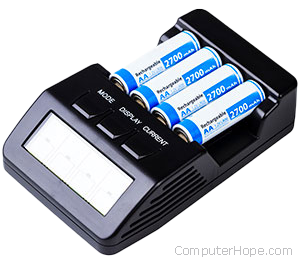
NiMH (nickel-metal hydride) batteries provide incremental improvements in capacity over the NiCad at the expense of reduced cycle life and lower load current.
Distinct advantages of today's NiMH batteries
Below are some advantages of NiMH batteries.
- 30% more capacity over a standard NiCad.
- Less prone to memory than the NiCad.
- Periodic exercise cycles need to be done less often.
- Fewer toxic metals. The NiMH is currently labeled "environmentally friendly."
Negative attributes of today's NiMH batteries
Below are some disadvantages of NiMH batteries.
- Number of cycles: The NiMH is rated for only 500 charge/discharge cycles. Shallow rather than deep discharge cycles are preferred. The battery's longevity is directly related to the depth of discharge.
- Fast charge: The NiMH generates considerably more heat during charge and requires a more complex algorithm for full-charge detection than the NiCad if temperature sensing is not available. (Most NiMH batteries are equipped with internal temperature sensing to assist full-charge detection). The NiMH also cannot accept as fast a charge as the NiCad; its charge time may be double that of the NiCad. The trickle charge must be controlled more carefully than on the NiCad.
- Discharge current: The recommended discharge current of the NiMH is considerably less than that of the NiCad. For best results, manufacturers recommend a load current of 0.2C to 0.5C (one-fifth to one-half of the rated capacity, see 3.1 C-Rate). This shortcoming may not be critical if the required load current is low. For applications requiring high power or a pulsed load, such as on GSM (Global System for Mobile communication) digital cellular phones, portable transceivers and power tools, the more rugged NiCad is the recommended choice.
- Self-discharge: Both NiMH and NiCad are affected by reasonably high self-discharge. The NiCad loses about 10% of its capacity in the first 24 hours, after which the self-discharge settles to about 10% per month. The self-discharge of the NiMH is one-and-a-half to two times higher than that of the NiCad. Selecting hydride materials that improve hydrogen bonding to reduce self-discharge can also decrease the battery capacity.
- Capacity: The NiMH delivers about 30% more capacity than a NiCad of the same size. The comparison is made with the standard, rather than new ultra-high capacity NiCad. Some ultra-high capacity NiCad cells provide a capacity level approaching that of the NiMH. Ultra-high capacity NiCad batteries cannot provide as high a load current as standard NiCad batteries. They are also less durable in terms of cycle count, but are longer lasting than NiMH batteries.