
Pentium
Code-named P5, the Intel Pentium was released by Intel on March 22, 1993, as a replacement to the 80486 processor and originally sold for $878.00. The name comes from the Greek word for "five" and is used because it's the fifth processor in the 80x86 line. It was supposed to be called the 80586, but the US court ruled that you cannot trademark a number. The Intel processors were available between speeds of 60 MHz and 300 MHz, had a 64-bit data bus, and had 1.9 million more transistors than the 80486DX (3.1 million). Below is a graphic illustration of the Pentium processor.
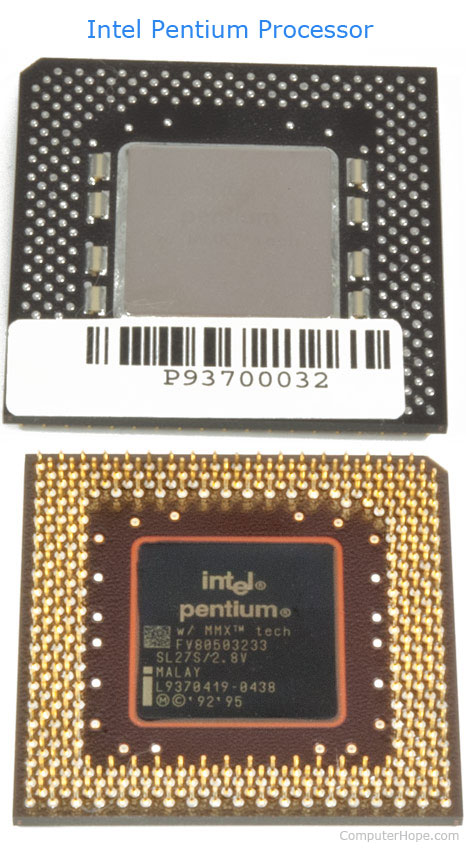
The original Intel Pentium was released using a 273-pin PGA form factor and ran on 5v power. Intel later announced the release of a second-generation introduced on March 7, 1994, included new processors from 75, 90, 100, 120, 133, 150, 166, and 200 MHz. The processors used 296-pin SPGA (staggered pin grid array) form factor that is physically incompatible with the first generation versions. The third generation of Pentium processors, code-named P55C, was introduced in January 1997, which incorporated the new technology MMX (MultiMedia eXtension). The Pentium MMX processors were available 166, 200, 233 MHz, and 266 MHz mobile version.
Other Intel Pentium processors include the Pentium II, Pentium III, Pentium 4, Pentium M, Pentium D, and Pentium Extreme. When compared with other Intel processors, the Pentium processors are faster than comparable Intel Celeron and Atom processors but slower than the Core processors.