
ASCII
ASCII may refer to any of the following:
1. Short for American Standard Code for Information Interchange, ASCII is a standard that assigns letters, numbers, and other characters in the 256 slots available in the 8-bit code. The ASCII decimal (Dec) number is created from binary, which is the language of all computers. As shown in the table below, the lowercase "h" character (Char) has a decimal value of 104, which is "01101000" in binary.
ASCII was developed and published in 1963 by the X3 committee, a part of the ASA (American Standards Association). The ASCII standard was published as ASA X3.4-1963, with ten revisions of the standard being published between 1967 and 1986.
ASCII sections
The ASCII table is divided into three different sections.
The standard ASCII consists of 128 (27) characters. Everything beyond standard ASCII is extended (28).
- Non-printable, system codes between 0 and 31.
- Lower ASCII, between 32 and 127. This table originates from the older American systems, which worked on 7-bit character tables.
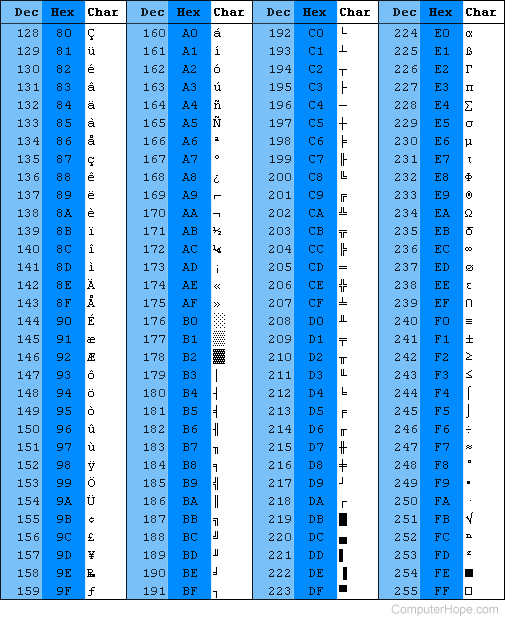
- Higher ASCII (extended ASCII), between 128 and 255. This portion is programmable; characters are based on the language of your operating system or program you are using. Foreign letters are also placed in this section.
Standard or lower ASCII characters and codes
| Char | Dec | Binary | Char | Dec | Binary | Char | Dec | Binary |
|---|---|---|---|---|---|---|---|---|
| ! | 033 | 00100001 | A | 065 | 01000001 | a | 097 | 01100001 |
| " | 034 | 00100010 | B | 066 | 01000010 | b | 098 | 01100010 |
| # | 035 | 00100011 | C | 067 | 01000011 | c | 099 | 01100011 |
| $ | 036 | 00100100 | D | 068 | 01000100 | d | 100 | 01100100 |
| % | 037 | 00100101 | E | 069 | 01000101 | e | 101 | 01100101 |
| & | 038 | 00100110 | F | 070 | 01000110 | f | 102 | 01100110 |
| ' | 039 | 00100111 | G | 071 | 01000111 | g | 103 | 01100111 |
| ( | 040 | 00101000 | H | 072 | 01001000 | h | 104 | 01101000 |
| ) | 041 | 00101001 | I | 073 | 01001001 | i | 105 | 01101001 |
| * | 042 | 00101010 | J | 074 | 01001010 | j | 106 | 01101010 |
| + | 043 | 00101011 | K | 075 | 01001011 | k | 107 | 01101011 |
| , | 044 | 00101100 | L | 076 | 01001100 | l | 108 | 01101100 |
| - | 045 | 00101101 | M | 077 | 01001101 | m | 109 | 01101101 |
| . | 046 | 00101110 | N | 078 | 01001110 | n | 110 | 01101110 |
| / | 047 | 00101111 | O | 079 | 01001111 | o | 111 | 01101111 |
| 0 | 048 | 00110000 | P | 080 | 01010000 | p | 112 | 01110000 |
| 1 | 049 | 00110001 | Q | 081 | 01010001 | q | 113 | 01110001 |
| 2 | 050 | 00110010 | R | 082 | 01010010 | r | 114 | 01110010 |
| 3 | 051 | 00110011 | S | 083 | 01010011 | s | 115 | 01110011 |
| 4 | 052 | 00110100 | T | 084 | 01010100 | t | 116 | 01110100 |
| 5 | 053 | 00110101 | U | 085 | 01010101 | u | 117 | 01110101 |
| 6 | 054 | 00110110 | V | 086 | 01010110 | v | 118 | 01110110 |
| 7 | 055 | 00110111 | W | 087 | 01010111 | w | 119 | 01110111 |
| 8 | 056 | 00111000 | X | 088 | 01011000 | x | 120 | 01111000 |
| 9 | 057 | 00111001 | Y | 089 | 01011001 | y | 121 | 01111001 |
| : | 058 | 00111010 | Z | 090 | 01011010 | z | 122 | 01111010 |
| ; | 059 | 00111011 | [ | 091 | 01011011 | { | 123 | 01111011 |
| < | 060 | 00111100 | \ | 092 | 01011100 | | | 124 | 01111100 |
| = | 061 | 00111101 | ] | 093 | 01011101 | } | 125 | 01111101 |
| > | 062 | 00111110 | ^ | 094 | 01011110 | ~ | 126 | 01111110 |
| ? | 063 | 00111111 | _ | 095 | 01011111 | 127 | 01111111 | |
| @ | 064 | 01000000 | ` | 096 | 01100000 |
Extended ASCII characters and codes
Extended ASCII uses eight instead of seven bits, which adds 128 additional characters. This gives extended ASCII the ability for extra characters, such as special symbols, foreign language letters, and drawing characters as shown below.
Extended or Higher ASCII characters and codes
How do you pronounce ASCII?
ASCII is pronounced as as-key.
Do all computers use ASCII?
Although most computers do use ASCII, other formats like EBCDIC (Extended Binary Coded Decimal Interchange Code) are still used with IBM mainframes and some tape drives.
Limitations of ASCII
Only having the ability to support 256 characters is limiting for many languages and impossible for Asia languages like Chinese. To help overcome this limitation, Unicode was created and adopted by all countries.
Convert text into ASCII
Use the following tool to convert any text into their Decimal ASCII values.
2. While in an FTP (file transfer protocol) session, ascii is also a command to switch to ascii file transfer mode.
ASCII Art, ASCII printer, Character code, Codepage, Computer acronyms, EBCDIC, Programming terms, Typography terms, Unicode