
Tilde

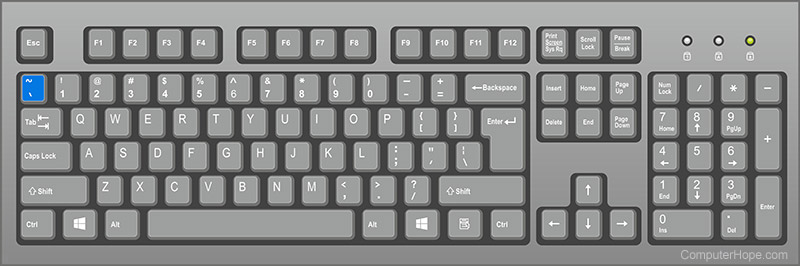
Alternatively known as the squiggly or twiddle, the tilde is a character ( ~ ) on keyboards below the Esc (escape key). It is on the same key as the back quote and resembles a squiggly line. The graphic represents how the tilde character may appear when typed.
Where is the tilde key on the keyboard?
Below is an overview of a computer keyboard with the tilde key highlighted in blue.
How to create the ~ symbol
Creating the ~ symbol on a U.S. keyboard
To create the tilde symbol using a U.S. keyboard, hold down Shift and press ~. This symbol is on the same key as the back quote ( ` ), in the top-left portion of the keyboard under Esc.
Creating the ~ symbol on a smartphone or tablet
To create a tilde on a smartphone or tablet's on-screen keyboard, tap the numbers button (123), then the symbols button (#+=). Then, tap the tilde (~) button.
What a tilde is used for on a computer?
Below are a few examples of why and when the tilde is used.
- In languages like Spanish, the tilde is a diacritical mark over letters (accent) such as 'ñ' and 'ã' to indicate alternate pronunciation of a consonant or vowel.
- Shorten long file names in Microsoft Windows 95 above. For example, changing the "Program Files" directory to the "Progra~1" directory.
- In regular expressions, the tilde can be used for pattern matching.
- In Excel, the tilde treats the following character as a literal character, not a wildcard. For example, to find cells containing a question mark, look for "~?" and not "?" in the Find what box.
- A file beginning with a tilde or a tilde and a dollar sign (e.g., ~$example.doc) is a temporary file.
- In C programming languages, the ~ represents a bitwise NOT.
- In chat, someone might use the tilde to help indicate they're flirting or being playful. For example, someone could say, "It's going to be an exciting night~~~" while in chat.
- Get to the home directory on a Linux computer (e.g., cd ~).
- Access the console in programs and games such as Quake.
- In mathematics, ~ indicates an approximate number.
- Access to the Tilda GTK+ terminal emulator.
- The tilde key can be used in keyboard shortcuts like Ctrl+Shift+~.
How to get a tilde above a letter
To place a tilde, or another accent mark, above a letter on keyboards, use the character map or the program's "insert special character" feature.
What is the other symbol on the tilde key?
On U.S. keyboards, the tilde key is shared with the back quote, which may be next to or below the tilde symbol.