
ATA
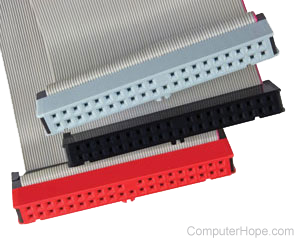
Short for Advanced Technology Attachment, ATA was approved on May 12, 1994, and is an interface that connects hard drives, CD-ROM (compact disc read-only memory) drives, and other drives. The first ATA interface is now commonly called PATA, which is short for Parallel AT Attachment after the introduction of SATA (Serial AT Attachment). Today, almost all home computers use the ATA interface, including Apple computers, which use SATA.
The ATA standard is backward compatible, which means new ATA drives (excluding SATA) can be used with older ATA interfaces. Additionally, any new feature introduced is in all future releases. For example, ATA-4 has support for PIO (programmed input/output) modes 0, 1, 2, 3, and 4, even though these were introduced in ATA-1 and ATA-2.
Below is a listing of each ATA standard to help provide a better understanding of the history behind this interface and each standards capability.
ATA, ATA-1, and IDE
First developed by Control Data Corporation, Western Digital, and Compaq, the ATA had an 8-bit or 16-bit interface, a transfer rate up to 8.3 MBps, and PIO modes 0, 1, and 2 support. Today, ATA and ATA-1, are considered obsolete.
ATA-2, EIDE, Fast ATA, Fast IDE, and Ultra ATA
ATA-2, commonly known as EIDE (enhanced integrated drive electronics), and sometimes known as Fast ATA or Fast IDE, is a standard approved by ANSI (American National Standards Institute) in 1996 under document number X3.279-1996. ATA-2 introduces new PIO modes of 3 and 4, transfer rates of up to 16.6 MBps, DMA (direct memory access) modes 1 and 2, LBA (large block addressing) support, and supports drives up to 8.4 GB. Today, ATA-2 is also considered obsolete.
ATA-3, and EIDE
ATA-3 is a standard approved by ANSI (American National Standards Institute) in 1997 under document number X3.298-1997. ATA-3 added additional security features and the new S.M.A.R.T feature.
ATA-4, ATAPI-4, and ATA/ATAPI-4
ATA-4 is a standard approved by ANSI on August 19, 1998, under document NCITS 317-1998. ATA-4 includes ATAPI (AT Attachment Packet Interface) packet commands and introduces UDMA/33, also known as ultra-DMA/33 or ultra-ATA/33, which supports data transfer rates of up to 33 MBps.
ATA-5 and ATA/ATAPI-5
ATA-5 is a standard approved by ANSI on December 13, 2000, under document NCITS 340-2000. ATA-5 adds support for Ultra-DMA/66, which can support data transfer rates of up to 66 MBps and has the capability of detecting between 40 or 80-wire cables.
ATA-6 and ATA/ATAPI-6
ATA-6 is a standard approved by ANSI on May 16, 2001, under document NCITS 347-2001. ATA-6 added support for Ultra-DMA/100 and has a transfer rate of up to 100 MBps.
ATA layout
The ATA interfaces above on a 3.5-inch disk drive have a 40-pin connector and can support up to two drives per interface. The below chart describes each of the pins on a 40-pin ATA interface.
A 2.5-inch hard drive uses a 50-pin connector and PCMCIA utilizes a 68-pin connector.
| Pin | Function | Pin | Function |
|---|---|---|---|
| 1 | Reset | 2 | Ground |
| 3 | Data 7 | 4 | Data 8 |
| 5 | Data 6 | 6 | Data 9 |
| 7 | Data 5 | 8 | Data 10 |
| 9 | Data 4 | 10 | Data 11 |
| 11 | Data 3 | 12 | Data 12 |
| 13 | Data 2 | 14 | Data 13 |
| 15 | Data 1 | 16 | Data 14 |
| 17 | Data 0 | 18 | Data 15 |
| 19 | Ground | 20 | Key |
| 21 | DDRQ | 22 | Ground |
| 23 | I/O Write | 24 | Ground |
| 25 | I/O Read | 26 | Ground |
| 27 | IOC HRDY | 28 | Cable Select |
| 29 | DDACK | 30 | Ground |
| 31 | IRQ (interrupt request) | 32 | No Connect |
| 33 | Addr 1 | 34 | GPIO_DMA66_Detect |
| 35 | Addr 0 | 36 | Addr 2 |
| 37 | Chip Select 1P | 38 | Chip Select 3P |
| 39 | Activity | 40 | Ground |
See the IDE (integrated drive electronics) term for a graphical representation of the cables, ports, and connections relating to ATA.
ATAPI, Computer abbreviations, EIDE, Hard drive terms, IDE, SATA