
IDE
IDE may refer to any of the following:
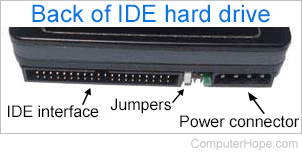
1. Short for Integrated Drive Electronics, IDE is commonly known as ATA or PATA (Parallel AT Attachment). It is a standard interface for IBM computers that was created by Western Digital and Compaq in 1986 for compatible hard drives and CD (compact disc) or DVD (digital versatile disc) drives. IDE is different than SCSI (small computer system interface) and ESDI (enhanced small disk interface) because its controllers are on each drive, meaning the drive can connect directly to the motherboard or controller. IDE and its updated successor, EIDE (enhanced integrated drive electronics), are common drive interfaces found in IBM compatible computers. Below is a picture of the IDE connector on a hard drive, IDE cable, and the IDE channels on the motherboard.
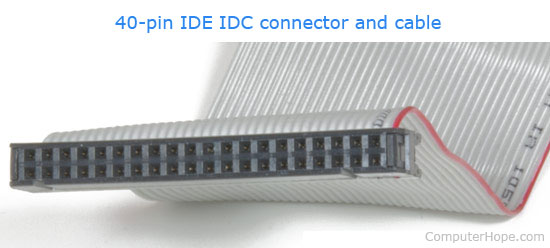
The location of the 1 pin (first pin) on an IDE cable is usually designated by the red stripe on one side of the cable. In the example picture above, the 1 pin is on the right side of the cable.
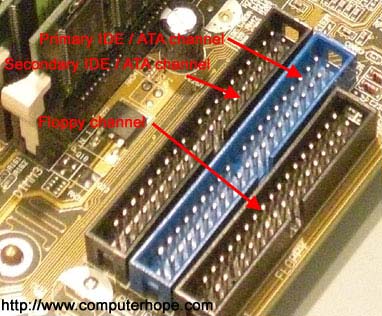
How many drives can each IDE channel support?
Each IDE channel can support two drives. A single IDE ribbon cable has three connection. One connection connects to the motherboard and the other two connections are available for the two drives.
2. Alternatively called IDLE, IDE is short for integrated development environment, and are visual tools that allow programmers to develop programs more efficiently. Commonly, an IDE may have a compiler, debugger, text editor, and other integrated tools. Smalltalk was the first programming language to have a first true IDE.
Below lists some popular IDE programs used by developers today.
- Code::Blocks
- IDLE (integrated development and learning environment)
- Eclipse
- Komodo
- Microsoft Visual Studio
- NetBeans
- PyCharm
- RubyMine
- Xcode
3. Short for integrated desktop environment, IDE is another name for a desktop environment and described early desktop environments like GlobalView.
ATA, Bus, Cable, Channel, Computer acronyms, Connection, Data cable, EIDE, Floppy cable, Hard drive terms, Hardware terms, IDLE, Integrated, Motherboard terms, .NET, PIIX, Programming terms, SATA, ToolboX