
SCSI

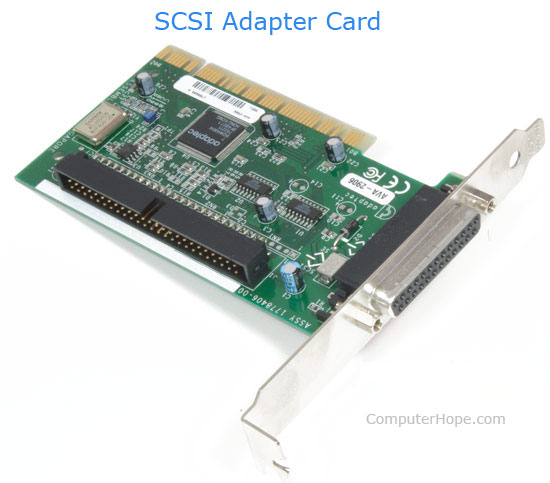
Short for small computer system interface, SCSI is pronounced as "Scuzzy" and is an interface for disk drives that was first completed in 1982. Unlike competing standards, SCSI can support eight devices, or sixteen devices with Wide SCSI. However, with the SCSI host adapter on ID number 07 and booting from the ID 00. This leaves the availability of six device connections. In the picture below, is an example of a SCSI adapter expansion card with an internal and external connection. Once installed in the computer, this adapter would allow multiple SCSI devices to be installed in the computer. More advanced motherboard may also have available SCSI connections on the motherboard.
SCSI-1 is the original SCSI standard developed back in 1986 as ANSI (American National Standards Institute) X3.131-1986. SCSI-1 can transfer up to eight bits a second.
SCSI-2 was approved in 1990, added new features such as Fast and Wide SCSI, and support for additional devices.
SCSI-3 was approved in 1996 as ANSI X3.270-1996.
SCSI is a standard for parallel interfaces that transfers information at a rate of eight bits per second and faster, which is faster than the average parallel interface. SCSI-2 and above supports up to seven peripheral devices, such as a hard drive, CD-ROM (compact disc read-only memory), and scanner. They can all attach to a single SCSI port on a system's bus. SCSI ports were designed for Apple Macintosh and Unix computers, but also can be used with PCs. Although SCSI was popular in the past, today it has largely been superseded by faster connection types, such as SATA (Serial AT Attachment).
SCSI connectors
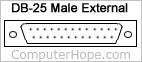
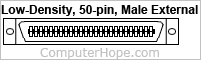
The illustrations below are examples of commonly-used SCSI connectors or SCSI ports on computers and devices.
|
|




Cable, Computer acronyms, Connection, Data cable, Fast Wide SCSI, Hard drive terms, Initiator, iSCSI, Phases, SAS, SCSI bus, SCSI cable, SCSI chain, SCSI device, SCSI-to-SCSI cable, Terminate, Ultra SCSI