
SSD
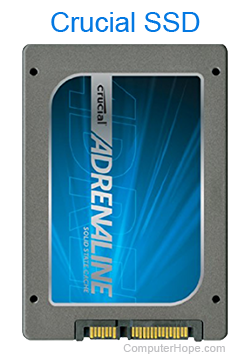
Short for solid-state drive, an SSD is a storage medium that uses non-volatile memory to hold and access data. Unlike a hard drive, an SSD has no moving parts, which gives it advantages such as faster access time, noiseless operation, higher reliability, and lower power consumption. The picture shows an example of an SSD made by Crucial.
As the costs have come down, SSDs have become suitable replacements for a standard hard drive in both desktop and laptop computers. SSDs are also a great solution for netbooks, nettops, and other applications that don't require a lot of storage.
Although an SSD uses flash memory, it should not be confused with a USB (universal serial bus) jump drive or Adobe Flash.
An SSD may also be short for solid-state disk, although it doesn't use a disk mechanism.
What are the different types of SSDs?
There are several types of SSDs with varying speed and connection types, including 2.5", mSATA, M.2, and PCIe. The following section briefly reviews each type.
- 2.5": This is the most common type of SSD on the market. They offer the best value per GB and, while being the slowest, are still plenty fast.
- mSATA: Short for Mini-SATA, these SSDs have a small form factor, a different connection type, and are a bare circuit board, unlike their enclosed 2.5" counterparts. They're a bit faster than a 2.5" SSD and are used in laptops and netbooks; devices where space is a concern.
- M.2: Like mSATA, these drives are a bare circuit board. The significant differences are that they come in both SATA and PCIe versions and have different lengths and widths, allowing for more flexibility. Also, M.2 SSDs can support NVMe (Non-Volatile Memory Express), which mSATA and 2.5" do not.
- PCIe: These are the fastest and most expensive SSDs. As the name would imply, they use a PCIe slot (the same slot your video card uses). They offer roughly four times faster speeds than a standard SATA drive.
What are the speeds of the different SSDs?
SSDs have traditionally used the SATA (Serial AT Attachment) connection, which has a theoretical maximum transfer rate of 750 MB per second. Newer generations of SSDs connect to the motherboard's PCIe connection, offering speeds of up to 1.5 GB per second. The PCIe (PCI Express) M.2 connection standard, introduced in 2014, offers a maximum real-world throughput of approximately 4 GB/s.
History of the SSD
Devices similar to the SSDs we use today were introduced in the 1970s. The early SSDs used core and DRAM (dynamic random-access memory) technologies to store information. For example, Dataram released the first SSD called the BULK CORE in 1976. The bulky device was only capable of storing 2 MB of data. The first semiconductor storage SSD was the StorageTek STC 4305, released in 1978, capable of storing 45 MB of data and costing $400,000.
Flash memory was later introduced and developed further in the 1980s, paving the way for the introduction of the first commercial flash-based SSD released by SunDisk in 1991. The SunDisk SSD was a 20 MB PCMCIA and available for around $1,000. Later, SanDisk (formerly SunDisk) released the first SSD with PATA (Parallel AT Attachment) interfaces in 1998.
Since SSDs were released, major improvements were made, prices have decreased, and storage capacities have increased to over 4 TB for home computers.
Computer acronyms, Hardware terms, Hybrid hard drive, NVMe, Solid-state device, Solid-state memory, Storage device